
If the phrase change order makes you immediately think, “How much more is this going to cost?” you are not alone.
For many homeowners, change orders are a major source of renovation anxiety. But a change order itself is not the problem. When handled properly, it is simply a written record of a decision that changes the agreed upon scope, price, and possibly schedule.
The real concern is what caused the change, and whether it could have been avoided.
At North Dallas Renovations, we believe a change order should document a decision, not surprise a homeowner with a problem that should have been anticipated, communicated, or included from the beginning.
A change order is a formal written amendment to the original construction agreement. It explains a change to the project and documents its effect on cost, schedule, or both.

A complete change order should clearly communicate:
That last point matters. Unless emergency conditions require immediate action to protect the home, homeowners should understand and approve a change before the related work proceeds. A verbal conversation in the hallway or a quick text about “adding one more thing” is not enough protection for either party.
A documented luxury renovation change order process keeps everyone aligned and prevents confusion when the project is moving quickly.
Most valid change orders fall into three categories. Understanding the difference helps homeowners evaluate whether a change is reasonable or a warning sign.
Sometimes a homeowner simply changes their mind or sees a new opportunity once construction is underway.
You may decide to extend cabinetry, upgrade the appliance package, add specialty lighting, or carry new flooring into an adjacent room. These decisions may improve the result, but they require additional material, labor, design work, or time.
Owner-requested changes are legitimate change orders because they alter the original, approved scope. The important thing is that the contractor clearly explains the complete cost and schedule impact before the homeowner commits.
Even with careful planning, portions of an existing home remain hidden until demolition begins. Behind walls, beneath flooring, or above ceilings, a remodeler may discover deteriorated framing, outdated wiring, improper plumbing, water damage, mold, or work completed without proper structural support.

These conditions are common in older Dallas neighborhoods such as Preston Hollow, Lakewood, and Bent Tree, where many homes were built decades ago under different codes and construction standards. A contractor cannot responsibly price the exact repair of a condition that was not visible before demolition.
However, “unforeseen” should not become a catch-all explanation. An experienced remodeler should anticipate common risks based on the home's age, construction type, and project scope, and discuss those possibilities during pre-construction.
A change may become necessary when the original documents must be revised because of engineering, permitting, code requirements, product availability, or a design decision that affects construction.
For example, an engineer may require additional structural reinforcement after selective demolition confirms how the home was framed. A specified material may be discontinued before ordering. The city may require an upgrade tied to the permitted work.
These can be legitimate changes, but they should be supported by clear documentation. The homeowner should understand what changed, why it changed, and how the cost was calculated.
Change orders should never be used to make an artificially low proposal profitable after a contractor wins the job. They should not become a substitute for detailed estimating, coordinated plans, or careful pre-construction work.
They also should not be used to charge for an item that was reasonably implied by the original scope but accidentally omitted from the estimate.
For example, if plans clearly show a wall moving and the contractor fails to account for the obvious flooring repair that results, that is a preventable estimating omission, not a homeowner decision.
In full transparency, we have had items missed in a final estimate. When that happens, we own up to the mistake and complete the change at no charge to the client.
No remodel is entirely free of change. But homeowners should not be expected to absorb the cost of poor documentation, incomplete estimating, or a contractor's failure to coordinate the project before construction begins.
Before hiring a remodeling contractor, ask how changes are identified, priced, and approved. Here is how a legitimate change order compares to a warning sign.
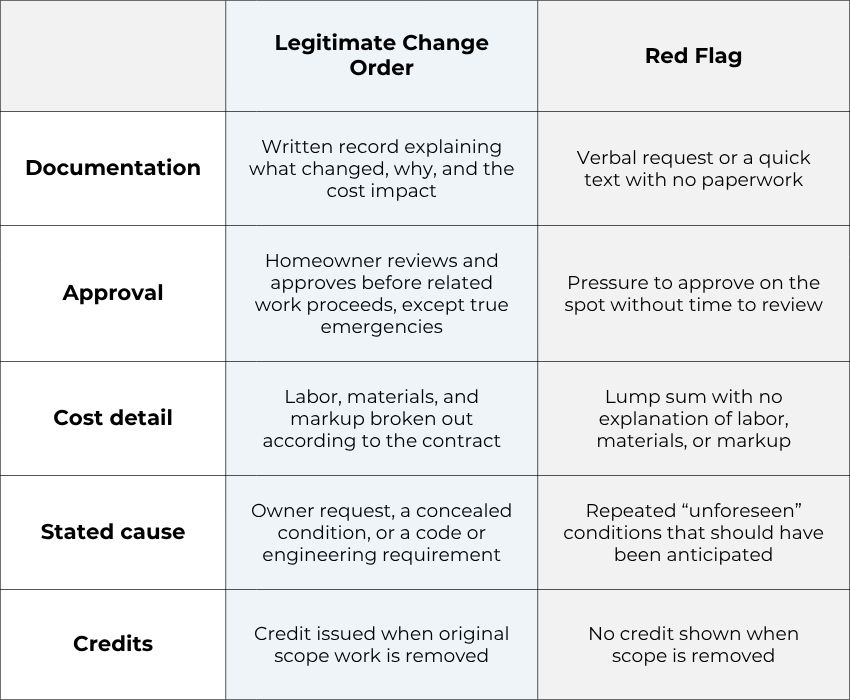
At North Dallas Renovations, we document changes through Buildertrend, a cloud-based construction management platform that connects remodelers, subcontractors, and clients in one centralized system. This gives clients real-time visibility and clear communication throughout the project, including daily logs, photos, and a central place for change orders and other communication.
The homeowner may approve or decline a change order. If approved, NDR schedules and completes the added or revised work. If declined, we do not proceed with that change, provided the work is optional and not required to address a safety, structural, or code issue.
This process creates a clear record of the decision and helps protect the budget, schedule, and original project scope. It also allows the homeowner to ask questions before authorizing additional work.
A change order may include costs for materials, trade labor, supervision, project administration, and contractor overhead and profit. That is normal. Added work still requires estimating, ordering, scheduling, coordination, quality control, and warranty responsibility.
What matters is transparency. Transparent pricing does not mean every change will be inexpensive. It means the homeowner can make an informed decision without guessing how the total was created.
This is so important.

The most effective way to manage change orders is to reduce preventable ones before construction begins. Our thorough pre-construction process, what we call the PSA phase, aligns the contractor, designer, architect, engineer, vendors, and key trades before demolition.
It is the stage where the team can verify field conditions, coordinate drawings, clearly define the scope, confirm material selections, validate lead times, and identify decisions that affect multiple parts of the project.
For a luxury renovation, that may include:
This work creates a more reliable budget and orderly construction experience. It also allows homeowners to compare options calmly, rather than under pressure with a crew waiting onsite.
Pre-construction cannot reveal everything inside an existing home, and it cannot prevent a homeowner from choosing to expand the scope. What it can do is dramatically reduce changes caused by incomplete selections, missed details, conflicting plans, and avoidable assumptions.
A well-managed renovation may include change orders, such as meaningful upgrades or repairs after demolition reveals damage. When disciplined, change orders become a clear record of informed decisions.
Planning a renovation in North Dallas, Plano, or Frisco? Trust North Dallas Renovations to safeguard your project with our proven process and meticulous planning. Schedule your consultation today with NDR and experience peace of mind.
A change order is a written amendment to a construction contract. It documents a change to the project scope and explains how that change affects cost, schedule, or both. In remodeling, a change order should always include the homeowner's approval before the related work begins.
Three categories account for most valid change orders: the homeowner requesting a new item or upgrade, a concealed condition discovered once demolition begins, and a required scope, design, or code change identified by an engineer, architect, or the city.
Yes, provided the work is optional and not required to address a safety, structural, or code issue. If you decline, the contractor should not proceed with that portion of the work and the original scope stays in place.
A thorough pre-construction phase aligns the contractor, designer, architect, engineer, and key trades before demolition. Confirming selections, verifying field conditions, and identifying long-lead materials early prevents many of the changes that come from incomplete plans rather than genuine surprises.
Watch for large portions of a proposal marked only as allowance or TBD, work shown on the plans but missing from the estimate, lump sum pricing with no breakdown, and a pattern of claiming predictable conditions were unforeseen.