If a whole home renovation or major remodel is on your wish list for 2027, it may feel early to start planning.
For a luxury renovation, it isn't.
One of the biggest misconceptions about remodeling is that the project begins when demolition starts. In reality, some of the most important work happens months before the first cabinet is removed or a wall comes down.
A thoughtfully executed renovation requires time to define the scope, establish a realistic investment, assemble the right team, develop the design, make selections, order materials, and prepare for construction.
The best renovations are not rushed into construction. They are thoughtfully planned for it.
A luxury renovation is not simply a larger version of a standard remodel.
Whole home renovations, major kitchen transformations, additions, and other substantial projects often involve structural changes, custom cabinetry and millwork, architectural details, specialty stone and tile, premium appliances, lighting plans, and extensive coordination between designers, builders, fabricators, and skilled trades.
And each decision affects another.
Appliance specifications affect cabinetry. Plumbing selections can determine rough-in locations. Lighting plans influence electrical work. Stone is templated after cabinetry installation. Moving one wall may affect framing, flooring, electrical, HVAC, and cabinetry.
For a substantial whole home renovation, design and selections can take several months, followed by many more months of construction. Scope, permitting, custom materials, and product lead times can extend that timeline further.
If you hope to renovate in 2027, start the planning conversation well before you want construction to begin.
Before choosing countertops or saving another kitchen photo, step back and ask a more important question: what isn't working about your home today?
Maybe the kitchen feels disconnected from the living area. Perhaps entertaining means guests congregate around the island while you are trying to prep dinner, dirty dishes are visible from the living room, and small appliances take up valuable counter space.
At first, you may think you simply need a larger kitchen.
But the better solution could be improving flow, reconfiguring adjacent rooms, adding a scullery or secondary prep kitchen, relocating storage, or creating a better connection between the kitchen and entertaining spaces.
That is why we start with how you live, not simply what you want your home to look like.
For larger renovations, aside from today's frustrations, how do you want this home to serve you five or ten years from now?
A clear vision helps your remodeler and designer determine which changes will have the greatest impact and keeps the project from becoming a collection of unrelated upgrades.
You do not need every detail selected before speaking with a remodeler.
You do need an honest conversation about investment.
We understand why homeowners sometimes hesitate to share a budget during an initial conversation. You may worry that revealing a number gives away negotiating leverage or encourages a contractor to spend up to that amount.
In reality, withholding the budget can make the early planning process less productive. Knowing your realistic investment range allows an experienced remodeler to tell you whether your expectations, scope, and desired level of finish are reasonably aligned. It also helps both sides determine something equally important very early in the process: are we the right fit for one another?
If you are envisioning a $750,000 whole home transformation but hoping to accomplish it for $350,000, it is better to identify that disconnect upfront. An honest conversation helps you decide whether to scale the renovation to meet your investment goal or look for another renovation team.
Transparency should work both ways.
Your remodeler should help you understand what is driving the investment. Structural work, electrical, plumbing, HVAC, custom cabinetry, and finish level all contribute to the cost. Allowances and specifications matter too. Two estimates can look dramatically different simply because they are not pricing the same scope or level of finish.
For a closer look at why luxury remodel pricing comes as a range rather than a single number, see our post on what drives luxury remodel costs.
The goal is not to finalize every dollar in the first conversation. It is to determine whether your vision and investment expectations align.
For a significant renovation, your remodeler, designer, and other key professionals should not operate in separate worlds.
The earlier the construction and design teams communicate, the more opportunities they have to evaluate feasibility, set priorities, identify potential challenges, and understand how design decisions may affect budget, schedule, and construction.
At North Dallas Renovations, we take a collaborative approach to design. Rather than having an in-house designer, we work with a trusted network of independent design professionals and can connect homeowners with a designer whose style, personality, and approach fit their project. Many are long-standing partners who are already familiar with our team, process, and standards.
Regardless of who you choose, the most important thing is that the designer and remodeler work together early. A beautiful concept still has to translate into cabinetry drawings, electrical and plumbing plans, material specifications, realistic allowances, lead times, and, ultimately, something that can be successfully built.
Assembling the right team early is also how well-documented, well-coordinated projects avoid the kind of preventable change orders we cover in our change order guide.
The goal is not simply a beautiful design. It is a beautiful design with a clear plan to bring it to life.
This is the fun part. It is also where hundreds of decisions are made.
Cabinetry. Appliances. Plumbing. Lighting. Countertops. Tile. Flooring. Hardware. Paint. Millwork. Doors. Specialty finishes.
Those decisions are not made in isolation.
Cabinet drawings may depend on final appliance specifications. Plumbing fixtures can affect rough-in requirements before walls are closed. A slab selection can influence countertop layouts and fabrication. Tile size may change a shower layout. Decorative lighting selections need to be coordinated with the electrical plan.
And custom cabinetry, specialty materials, and certain fixtures can have significant lead times.
This does not mean you must complete every selection before construction can begin. Sometimes design, procurement, and construction can overlap when the plan is clear and decisions are prioritized appropriately.
But there is an important difference between strategically overlapping phases and making decisions at the last minute.
A strong pre-construction process identifies which decisions must be made first, which materials need to be ordered early, and which selections can safely happen later without disrupting the schedule.
Giving design the time it deserves does not slow down a renovation. It helps construction move more efficiently once it begins.
Every project is different, but this is roughly how a well-planned luxury renovation unfolds from first conversation to move-back-in day.
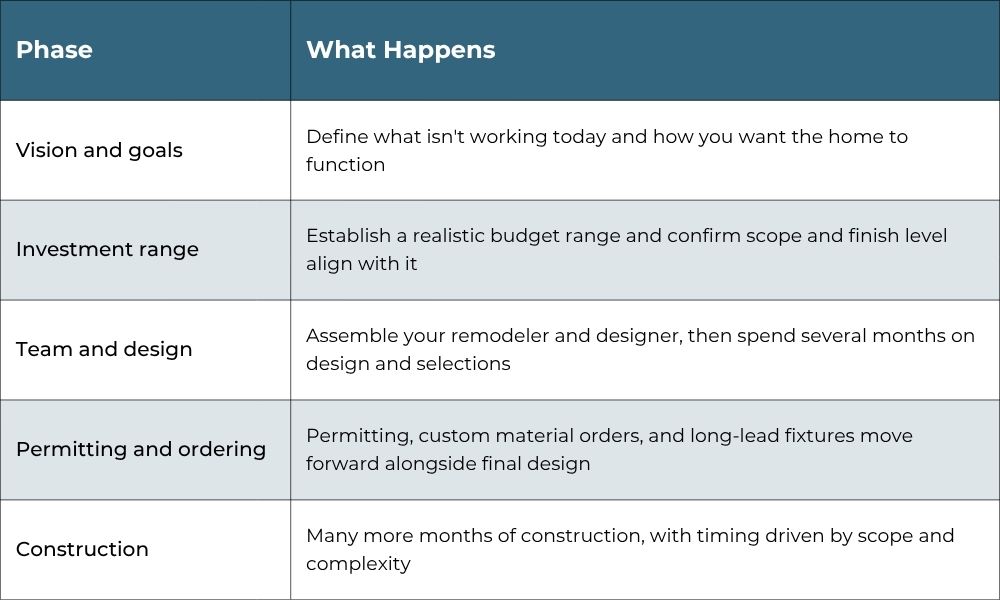
If you are considering a significant renovation in 2027, you do not need every answer today. You just need a starting point. Begin by envisioning how you want to live, establishing a realistic investment range, and assembling the right team. Starting early gives you the time to make thoughtful decisions and ensures your project is ready when construction begins.
At North Dallas Renovations, we believe the remodeling experience should be as thoughtfully planned as the finished home itself, whether that home is in Preston Hollow, Plano, Frisco, or anywhere else in North Dallas. If a 2027 renovation is on your radar, now is the time to begin the conversation. We would love to talk with you.
For a substantial whole home renovation, design and selections alone can take several months, followed by many more months of construction. Scope, permitting, custom materials, and product lead times can extend that timeline further, which is why starting the planning conversation early matters.
Months before you want construction to begin. The most important early work, defining your vision, establishing an investment range, and assembling the right team, happens well before demolition, not once it starts.
An honest conversation about investment early in the process lets an experienced remodeler tell you whether your expectations, scope, and desired finish level are reasonably aligned, so you can adjust the plan or the budget before design work is underway.
No. Design, procurement, and construction can strategically overlap when the plan is clear and decisions are prioritized. A strong pre-construction process identifies which decisions must be made first and which can safely happen later.